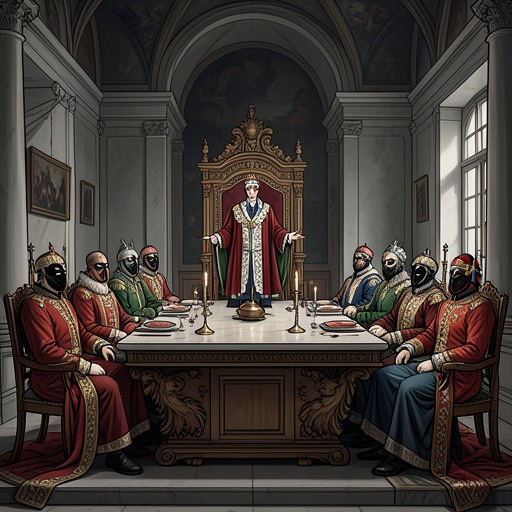
The golden prince
The King's CurseThe golden prince is Margaret Pole’s name for the promise Henry VIII once seemed to embody: a handsome and generous king, a source of dynastic hope, and a ruler capable of bringing peace. Its later force comes from the contrast between that promise and the man Margaret sees harden after the execution of Edward Stafford, Duke of Buckingham, and collapse into grief over the death of Henry FitzRoy.
The promise of a golden king
Margaret’s ideal of Henry rests on more than appearance. At the Field of the Cloth of Gold, she sees him as stylish, generous in politics, and sincere in his pursuit of peace. Beside him, Katherine of Aragon takes her place on a great European stage, and Margaret feels pride in the couple’s apparent accord and in the prospect of peace with France and prosperity in England. The splendour of the meeting is matched, in Margaret’s eyes, by the promise of a settled and loving royal partnership.
That image is also bound to the succession. When Katherine goes into premature labour, the court silently hopes for a son: his birth, Margaret imagines, would answer those who have called the queen weak or cursed, restore her standing, and make the king’s attention turn back to her. The golden king is therefore not only a charismatic individual. His promise depends on a royal household able to secure the future through a male heir, and on the queen’s capacity to provide one.
The first fracture
The death of a newborn prince makes that dynastic hope painfully precarious. The king had entrusted Margaret with the expectation that she would raise England’s next king; instead, she is called to the nursery when the baby is found lifeless. The loss gives the image of the golden prince a shadow: the future Margaret had been asked to nurture cannot be separated from the vulnerability of the royal line.
Buckingham’s execution marks a different kind of rupture. Margaret and others expect Henry to pardon his kinsman and constant companion, but he sends him to execution. Margaret says nothing in Buckingham’s defence, and later wonders whether her silence makes her complicit in the change she observes. She describes Henry as harder in both gaze and heart, and interprets the king’s response as the result of a hidden fear of not being good enough, provoked by Buckingham’s pride and confidence. The golden image does not vanish at once; it becomes something Margaret tries to preserve even as the king’s conduct contradicts it.
Margaret’s faith in Henry
After her family is banished from court, Margaret lives quietly at Bisham Manor. Henry releases her son Montague without charge and does not extend the punishment through the family, which Margaret takes as evidence that the king has returned to himself. She continues to believe that the boy she loved in childhood will summon her back and allow her to resume her place with Princess Mary.
Her confidence is sustained by memory as well as by the king’s restraint. Margaret recalls Henry as a golden prince who had seemed incapable of wrongdoing, but recognizes that this had been too high a standard for any young man. She still believes he will recover, partly because she cannot imagine that her cousin Elizabeth of York could have raised a son who was not loving and trustworthy. The epithet thus records Margaret’s attachment and hope, not an unchanging judgment: she sees the danger, yet continues to measure Henry against the child and young man she remembers.
Grief and the broken image
When Henry FitzRoy dies, Henry’s grief brings Margaret face to face with a king unlike the assured figure she once admired. He asks whether a curse explains why he has lost those he loves and why he is so wretched. Margaret does not affirm the explanation. Her silence echoes her earlier failure to speak for Buckingham, but here it also leaves the king alone with his own account of suffering.
The scene sharpens the divide between royal status and personal vulnerability. Henry has adopted the imperial title of Majesty, yet his grief leaves him dependent on attendants to help him to bed. The public authority of the king and the suffering of the bereaved father occupy the same body. By setting this collapse against the earlier image of the golden king, the narrative turns the epithet into both a memory of lost promise and a measure of how far Margaret’s hope has been tested.